Coming back to climbing can feel like trying to tune a guitar while the band’s already playing. There’s no single number that captures a session: grades matter, but so do the number of climbs, route length, wall angle, holds, and style. A short, steep boulder problem can hit very differently from a long, steady route, even if they’re technically the same grade.
You can’t boil all of that down to a perfect formula. But you can make a useful scorecard to keep track of what you’re doing and how your body responds. Just like using a map (for the youngsters, maps used to be on paper without a blue dot showing your location), you have to know where you are to know where to go. Here is the framework that we use at The Climbing Project to create measurable return-to-climbing plans.
Add up the session
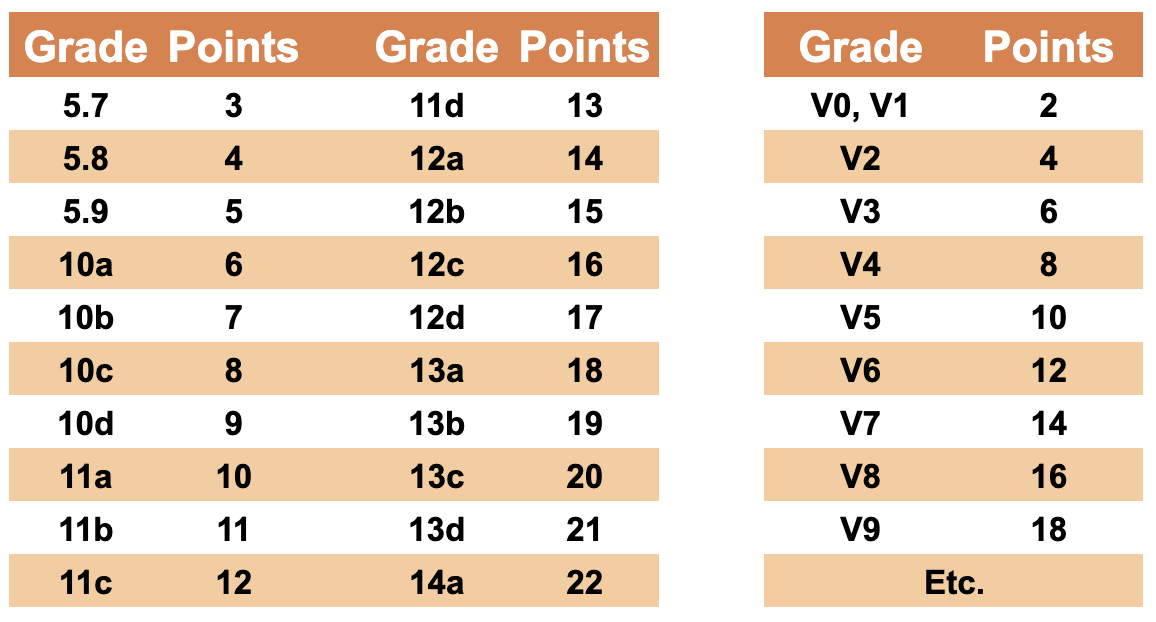
The idea is simple: use the point values in the chart below to score each climb. Add them together to get your session’s Total Load.
Say you climb three problems worth four points each and two worth six points each. That gives you a Total Load of 24. The score doesn’t measure exactly what your body can handle; it gives you a consistent way to compare one session with another.
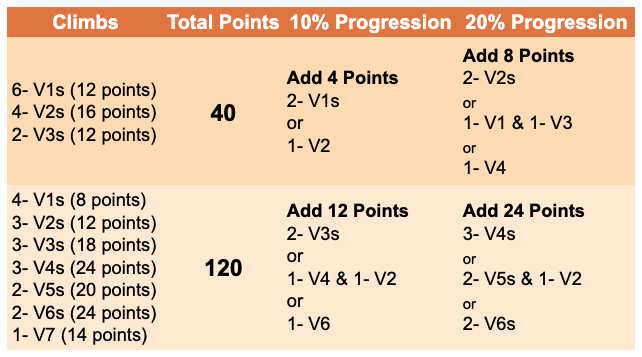
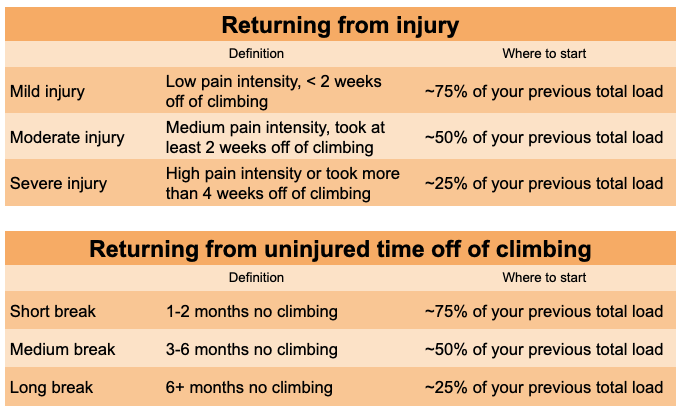
If you have a good idea of what a typical session looked like before your break or injury, use that as a reference for where to start your return-to-climbing journey.
Let the next day have a say
A session can feel great while you’re warmed up, but our tissues haven’t been going to therapy recently so they need some extra time to process their emotions. Check in after climbing and again the next day. Use the traffic-light chart to help decide what to do next.
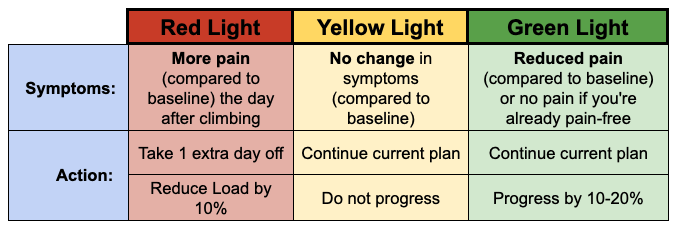
Pro beta: don’t crank every knob at once. Adding harder climbs, more attempts, and a longer session all together makes it tough to know what changed the picture. Pick one thing to adjust and see how it goes.
Grade is only part of the story
A grade gives you a rough idea of difficulty, but it doesn’t tell you exactly what a climb demands. A steep crimp ladder, a technical slab, and a juggy overhang can all feel like different sports.
Consider the styles and holds that make a session feel harder for you. If crimps take more out of you, keep the crimp-heavy climbs in check. If steep terrain is your weakness, count it as extra load even when the grade looks familiar. You can note those details in your log or adjust the score to reflect them.
It’s also useful to group climbs by how hard they are for you: limit climbs, near-limit projects, climbs around your onsight or flash level, and easier mileage. The same grade can land in a different group for different climbers, so use your own current climbing as the reference. Near-limit attempts usually cost more than easy laps, even when the session’s total number of climbs is the same.
Keep the score in perspective
Total Load is a planning aid, not gospel. Pair it with notes about what you climbed, how it felt, and how you felt afterward. Over time, that record can help you spot patterns and choose a sensible next session.
Progress doesn’t happen in a straight line. Some days feel strong; other days, the wall wins. Keep the changes gradual, pay attention to your response, and build your way back one solid session at a time. No need to go full send on day one.
It’s hard to hold back when gradually returning to climbing.
The climber in me sees the climber in you. We can do this!